— Beauty & Skincare, Verified for Six Weeks
CurvLife Semi Solid Nail Glue Review: Two Week Press-Ons?
A 15g semi-solid paste that promises gel-strength hold with no lamp. We read 6,417 ratings and every buyer report on file to see whether the format really outlasts thin liquid glue.
The Full Verification Report
This article is reader-supported. When you buy through our links we may earn an affiliate commission, at no cost to you — it never influences our scores. As an Amazon Associate we earn from qualifying purchases.
Press-on nails have a reputation problem, and it is almost never the nails. It is the glue. The thin, watery adhesive that comes free in the packet floods the cuticle, dries in seconds before the tip is seated, and surrenders the first time you wash a pan. CurvLife Semi Solid Nail Glue sets out to fix that by changing the consistency entirely.
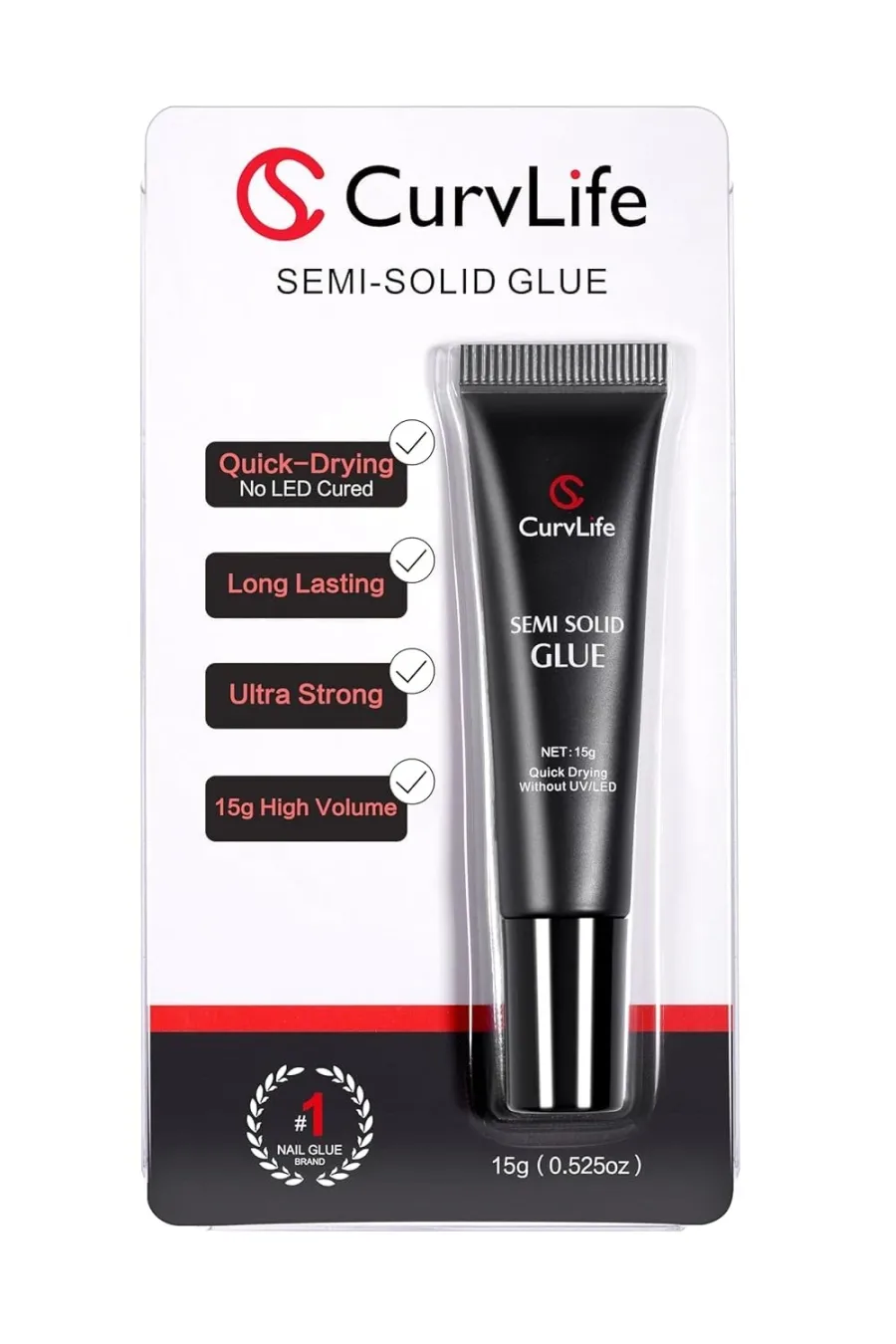
This is a 15g paste rather than a liquid, and the listing rates its viscosity as medium to high. It holds a rank of #3 in False Nail Glue on Amazon and carries a 4.5-star average across 6,417 ratings, which is a substantial evidence base for a product in this category. We read every scraped buyer review on file to work out whether the format genuinely changes the outcome.
Why Press-On Nails Fall Off, and What a Semi-Solid Paste Changes
A press-on fails at the edges first. Water creeps under a lifted corner, the bond softens, and within a day the whole tip pops. Thin glues make this likely because they self-level: you place a drop, it runs toward the cuticle, and the apex of the nail where you needed adhesive ends up bare.
A paste at medium-to-high viscosity behaves differently. It stays where you put it, which means you can load the centre of the tip and the stress point near the free edge rather than watching the product migrate. Several buyers describe exactly this benefit in their own words, calling the semi-solid consistency far easier to control and noting that it does not run everywhere during placement.
It also fills space. One reviewer with strongly curved nail beds bought it specifically because she needed something that could bridge the gap between her natural curvature and a flatter tip, and reported that it did so without the damage her previous glue caused. A thin adhesive cannot do that job at all.
What You Actually Get in the Tube
The listing is unusually forthcoming for this category, so the specifications are worth stating plainly rather than guessing at. It is a clear, resin-based paste supplied in a single tube.
- 15g net, listed as 15 ml, at a stated item weight of 0.529 ounces
- Clear when dry, with a resin material type
- Container type given as a tube, and the included component listed simply as gel
- Viscosity rated medium to high, with fast drying listed as a special feature
- Full cure time stated as one hour
- Water resistance level listed as water resistant
- Compatible materials given as acrylic and plastic
Two of those figures deserve emphasis because buyers routinely misread them. The one hour is a full cure, not a set time, and the glue grabs long before that. The water resistance is a rating on the listing, not a waterproof claim, and it is the single spec that best predicts whether a set survives a week of real life.
Hold Strength: What the Buyer Reports Actually Say
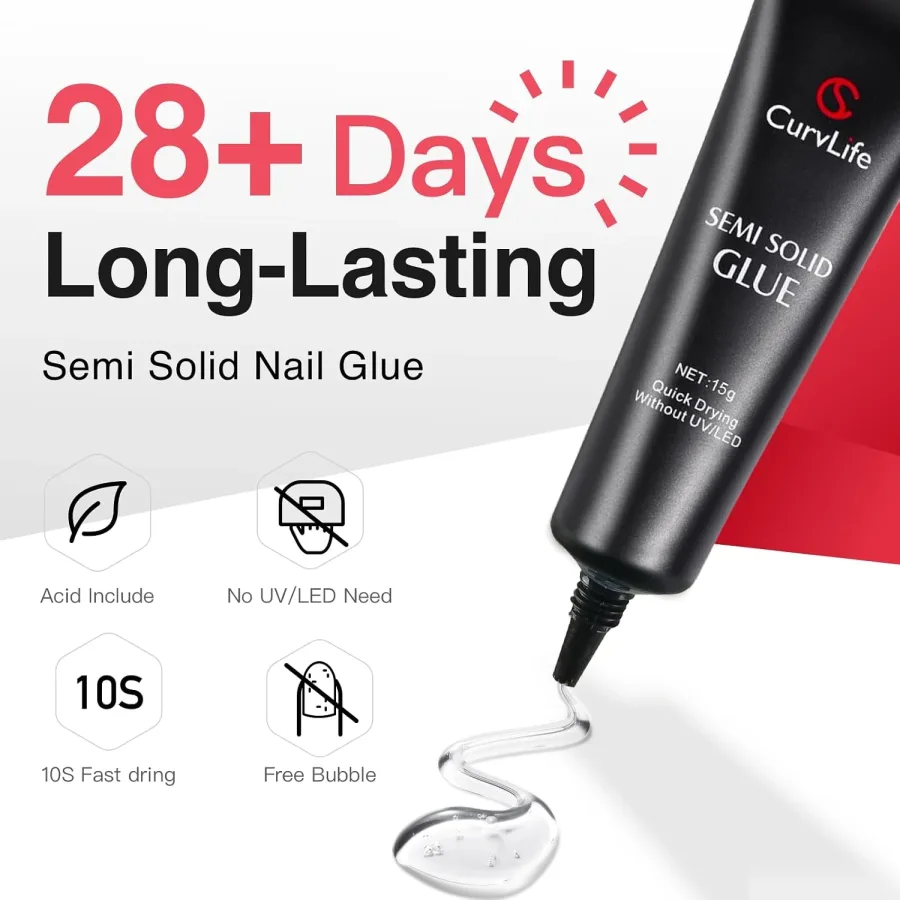
The consistency of the wear reports here is the most striking thing in the file. Across the genuine reviews on record, two weeks is the floor rather than the ceiling, and three weeks appears repeatedly.
One buyer documented three full weeks with photographic proof of the grow-out and said not one tip had budged, despite constantly buckling car seats and washing dishes. Another, who has worn press-ons almost continuously for five years, called it the strongest of roughly twenty liquid glues she had tried and said it reliably gets her a solid fortnight. A third reached day ten across a rock concert and a music festival.
What makes these accounts credible is how specific the failure points are. The two-and-a-half week wearer removed her set because a natural nail broke underneath, not because the adhesive gave up. That is a meaningfully different outcome from a tip simply falling off.

No Lamp, No Cure, and Why That Matters to Some Buyers
Gel-based nail adhesives need a UV or LED lamp to harden. This one does not, and the listing makes no curing claim of any kind. For a good number of buyers in the file, that is the entire reason they bought it.
One reviewer states plainly that she has a gel allergy and had been growing her natural nails out because of it. Another had spent years looking for something with no UV cure, having become sensitised to gel products. A third compared it directly to the UV glue she normally uses and judged it just as strong without the lamp step.
We want to be careful here. The listing makes no hypoallergenic or sensitivity claim, and nothing in the data supports treating this as a solution to an adhesive allergy. What the evidence does support is narrower and still useful: it performs at gel-glue strength without requiring a curing step, which removes one variable for people who have reacted to cured gel products.
Water Resistance Against Dishes, Pools and Constant Handwashing
Water is the enemy of every press-on, so the water-resistant rating is the spec most worth interrogating. The reviews give it a genuinely hard test.
A self-described germaphobe who cooks and washes dishes constantly reported that not a single nail moved. A cleaner who is also a cash handler, and who washes her hands relentlessly, tracked a set from the 2nd to the 17th of the month and was still wearing it. Another buyer simply noted that she washes dishes often and the water resistance functions well.
These are not gentle-use accounts, and they come from different people describing the same outcome. On the available evidence the water-resistant rating is doing real work rather than sitting on the listing as decoration.
Prep Is Not Optional, and the Reviews Are Blunt About It
The most useful advice in the entire file comes from buyers, not the brand. Nearly every long-wear account describes a prep routine, and the one notably shorter result comes with an explicit warning attached.
- File the surface of the natural nail so the glue has texture to grip
- Push back and tidy the cuticle so no adhesive bridges onto skin
- Clip and buff before you size anything, since a smooth shiny nail plate sheds adhesive
- Dehydrate the nail immediately before application
- Roughen the inside of the press-on itself so the paste can key into it
- Apply to both surfaces, a layer on the natural nail and a lighter coat inside the tip
One reviewer opened with a capitalised instruction not to forget filing, calling prep the most important part of the process, and got a week to ten days. Set against the three-week accounts from people who dehydrate and buff, the pattern is hard to miss.
Semi Solid Against Brush-On and Cured Gel Glue
One reviewer in the file has worked through all three adhesive formats and describes each failure mode precisely, which makes her account the most useful comparison available. She uses full-cover gel tips regularly and has tried a range of applications.
Ordinary brush-on glue she found too brittle. Her nails either did not last, or lasted and then tore her nail beds coming off, which is the classic signature of a hard, thin adhesive with no flex. Cured glue solved the strength problem but introduced the lamp, the curing time and the sensitivity issues that come with gel chemistry.
The paste sits between those poles. It reaches gel-adjacent strength while staying flexible enough to release in a warm soak, and it needs no equipment. That reviewer now keeps two tubes at home plus smaller ones in every handbag and at work, which is a fair summary of how strongly the format converts people once it works for them.
Using It on One Problem Nail Instead of a Full Set
A use case worth flagging, because it is not how these products are usually marketed. One buyer has a thumbnail that grows irregularly and was not looking for a full manicure at all. Her plan was to apply a single press-on to the problem nail and paint the other nine herself.
This works precisely because the adhesive is a controllable paste. A single tip on a misshapen nail needs gap-filling and precise placement far more than a full uniform set does, and a thin liquid would run off the uneven surface. It is also the cheapest possible use of a 15g tube.
The same logic applies to repairing a break mid-set. Because the listing gives compatible materials as acrylic and plastic, the paste covers both the tip you are replacing and most constructions you are replacing it on.
What It Costs Per Set
Value in this category is not about the sticker price, it is about how many sets a tube delivers and how long each set survives. On both measures the arithmetic is favourable.
A full set uses a small quantity per nail, and the tube holds 15g. Buyers describe it lasting a long time, and the stockpiling behaviour in the reviews tells its own story: one reviewer keeps spares specifically in case the product is ever discontinued, which is not how people treat a consumable they expect to replace monthly.
Set that against wear time. If a set survives two to three weeks rather than three days, the cost per worn day collapses, and so does the number of times you sit down to redo them. That is where the real saving lives.
Does It Actually Pass for a Salon Set?
Several buyers reach for the same comparison unprompted, which is worth reporting because it speaks to finish rather than adhesion. One said everyone assumed she had her nails done professionally. Another, wearing a set through two music events, said they felt like actual enhancements rather than something stuck on.
The clear, resin-based formula is doing part of this work. A glue that dries clear leaves no visible line where the tip meets the natural nail, and the paste's tendency to stay put rather than flood the cuticle avoids the give-away ridge of hardened adhesive along the skin.
A reviewer who had switched away from acrylics after a nail technician's sets kept breaking and lifting within days now gets a better result at home. That is a meaningful comparison, though a single account rather than a pattern.
Removal Without Wrecking the Nail Underneath
A glue this strong raises an obvious question, and the file answers it. The method buyers describe is a soak rather than a pry.
The most detailed account involved warm water with dish soap and a little oil, followed by gently loosening the sides with a cuticle pusher. That reviewer reported a clean removal after two full weeks. Another noted that with the right process the glue comes away without harming the nail bed, and a buyer with flimsy, easily peeling nails was surprised to find almost no damage.
The honest caveat is that removal is a deliberate, patient job here rather than a quick one, and impatience is where damage enters. Anyone who reaches for acetone rather than a warm soak should read our comparison of the options in our guide to 100% pure acetone removers before deciding which approach suits their nails.
Where It Falls Short
Dosing is the recurring complaint. One reviewer said outright that it is very difficult to judge how much to apply, and that is the natural trade-off of a paste: you cannot watch a drop spread to tell you it is enough. Expect a few sets before you calibrate, and expect early attempts to squeeze out too much.
The strength itself is double-edged. A buyer who removed a set early, while the bond was still fully intact, reported damage and could see moisture trapped underneath. This adhesive rewards leaving the set alone until grow-out makes removal natural, and punishes changing your mind on day three.
It is also a glue and nothing else. The 15g tube of CurvLife Semi Solid Nail Glue contains no remover, no prep pads and no buffer, so budget for those separately if you are starting from nothing.
What to Pair It With
Because the tube ships alone, the surrounding kit matters. The listing gives compatible materials as acrylic and plastic, which covers essentially every mainstream press-on construction, so the nails themselves are an open choice.
Full-cover tips in a harder plastic benefit most from a gap-filling paste, since they flex less to meet a curved nail bed. Sets like the BTArtbox Gold End Short Almond Press On Nails sit in that category, and one reviewer in the file pairs this glue with tips from the same brand that sells it.
For removal, a warm soak is the buyer-endorsed method rather than a solvent. If you keep acetone for cleaning up residue afterwards, a controlled pump bottle such as Glamonade Acetone Nail Polish Remover wastes less than a free-pour bottle. Keep it for the tidy-up, not for dissolving the bond.
Specifications at a Glance
| Specification | Listed value | What it means in use |
|---|---|---|
| Size | 15g / 15 ml | Buyers describe the tube lasting a long time |
| Item form | Paste | Stays where placed instead of flooding the cuticle |
| Viscosity | Medium to high | Thick enough to fill gaps under curved nail beds |
| Full cure time | 1 hour | Grabs far sooner; this is the full-strength mark |
| Water resistance | Water resistant | Survives dishwashing in repeated buyer accounts |
| Compatible materials | Acrylic, plastic | Covers most press-on and tip constructions |
| Curing | None stated | No UV or LED lamp needed at any stage |
| Colour | Clear | No visible line at the smile line when dry |
| Amazon rating | 4.5 / 5 from 6,417 ratings | #3 in False Nail Glue |
Who It Suits, and Who Should Look Elsewhere
Buy it if you want a set to survive two weeks or more of ordinary domestic life, if you have curved nail beds that thin glues cannot bridge, or if you want gel-level hold without owning a lamp. Parents, cleaners, cash handlers and frequent handwashers are exactly the demographic reporting the best results.
Skip it if you like changing your nails every few days. The strength of the CurvLife semi-solid formula works against you if you remove sets early, and a gentler adhesive will treat your nail plate better. If you are still choosing the nails themselves rather than the glue, our roundup of the best press on nails is the more useful starting point.
The Verdict
This is the rare nail product where the structured specifications and the buyer testimony point in precisely the same direction. A medium-to-high viscosity paste should theoretically control placement, fill gaps and resist water better than a thin liquid, and 6,417 ratings averaging 4.5 stars say it does.
It is worth being clear about what this product is not. It is not a repair treatment, it makes no claim to strengthen the nail underneath, and the listing describes no skin-safety testing of any kind. It is an adhesive, judged on whether it adheres.
On that single measure the record is strong. A 4.5-star average across 6,417 ratings, a #3 category rank, and a review file in which the shortest genuine wear report is about a week all point the same way.
The weaknesses are honest ones. Dosing takes practice, removal demands patience, and nothing is included beyond the adhesive itself. None of those undermine the central claim. For anyone who has cycled through liquid glues and watched tips lift by day three, CurvLife Semi Solid Nail Glue is a genuinely different proposition rather than a louder version of the same thing.
Confirmed
- Buyer reports cluster at two to three weeks of wear, with several documented three-week sets
- Semi-solid paste stays where placed instead of flooding the cuticle like thin liquid glue
- No UV or LED lamp needed at any stage, unlike gel-based nail adhesives
- Water-resistant rating holds up in repeated accounts from dishwashers and frequent handwashers
Flagged
- Dosing is hard to judge, and buyers report a learning curve of a few sets
- Removing a set early, before natural grow-out, risks damage and trapped moisture
- Supplied as glue only, with no remover, prep pads or buffer included
- Requires genuine prep (file, buff, dehydrate) or wear time drops sharply
Specification
Verified Against 2 Rivals
This Product
CurvLife Semi Solid Nail Glue, 15g Strong Nail Glue for Press On Nails
9.0 / 10
DND Base Gel & Top Gel No Cleanse Duo
9.1 / 10
OPI Nail Lacquer Start to Finish Base Coat
8.9 / 10How This Score Was Earned
We Purchase
Bought at retail, anonymously, with our own funds.
We Live With It
A minimum of four weeks of daily use before a word is written.
We Measure
Weighted criteria, identical for every product in the category.
We Re-Verify
Rankings are revisited weekly; scores fall when products do.
 Verified Examiner
 The Verified Verdict
A medium-to-high viscosity paste that delivers gel-strength hold with no lamp, and the rare nail product where the listed specs and the buyer testimony agree completely. Two to three week wear is the norm rather than the exception.
Check Price on Amazon →$8–$13 · price verified today
Common Questions