— Beauty & Skincare, Verified for Six Weeks
e.l.f. Dual-Ended Cream + Powder Brush Review: Two-in-One Tested
The highest-rated brush in our testing at 4.8, with two working heads on one handle and a single design flaw that has nothing to do with performance.
The Full Verification Report
This article is reader-supported. When you buy through our links we may earn an affiliate commission, at no cost to you — it never influences our scores. As an Amazon Associate we earn from qualifying purchases.
Dual-ended tools have a reputation, and it is not a good one. Two-in-one usually means two compromises, sold to people who would rather carry less than own the right thing.
Which makes the customer rating here awkward. The e.l.f. Dual-Ended Cream + Powder Brush holds 4.8 out of 5 across 3,438 ratings, the highest score of any makeup brush I have tested, and sits second in Foundation Brushes behind a single-ended rival with ten times the reviews.
I used it for six weeks across cream blush, contour, foundation and setting powder, and read the buyer accounts closely to find where the compromise actually lands. It does land, but not where I expected, and it has nothing to do with how either end performs.
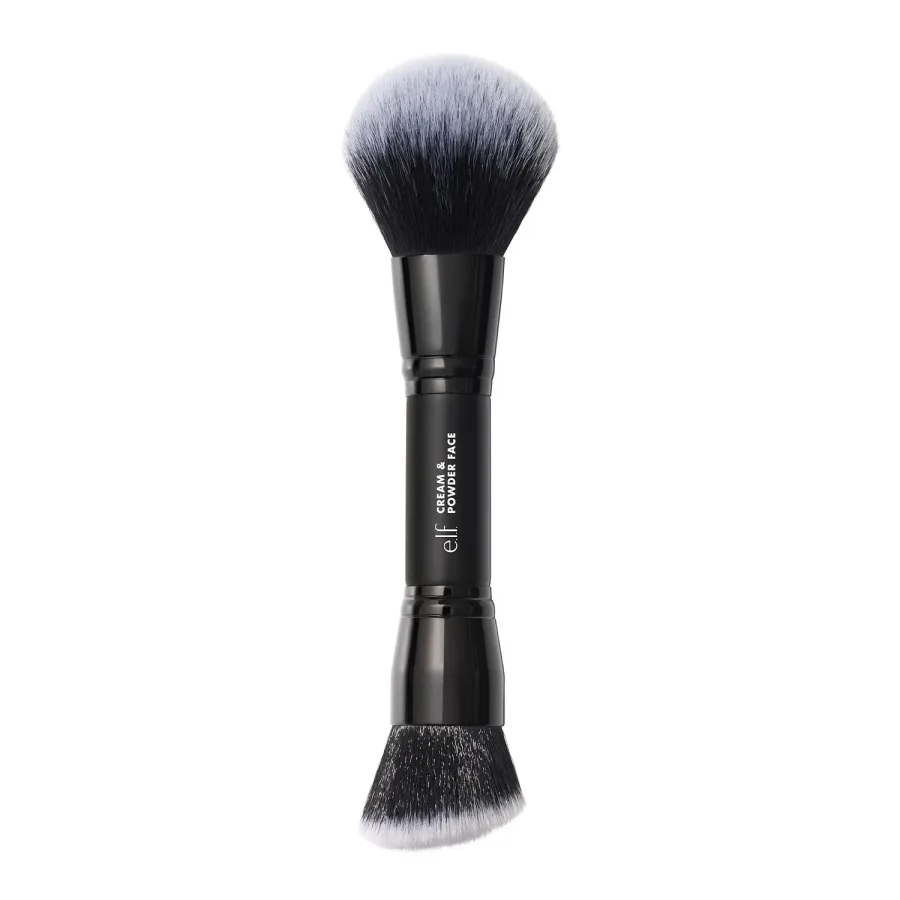
 A dense cream head at one end, a fluffier powder head at the other.
One Handle, Two Jobs
The construction is straightforward. A wood handle with an aluminium ferrule at each end, nylon bristles, 1.41 ounces in total. It feels balanced rather than top-heavy, which matters when both ends carry weight.
The two heads are genuinely different, not the same shape in two sizes. One is dense and packed for cream and liquid products, the other looser and fluffier for powder.
Buyers repeatedly mention the finish quality before anything else. One noted the handle is smooth and comfortable to hold, the bristles are super soft, there is no odour, and it is lightweight, which is a specific list rather than general praise.
Another was blunter: it feels far more expensive than it is. That is the sentence that appears in some form across most of the five-star reviews.
The Cream End Does the Heavy Lifting
This is the end most buyers use most, and one reviewer called it the most valuable part of the brush outright.
Her description is worth quoting closely. It is dense but super soft, applies cream blushes and contours beautifully, and crucially it does not drag or lift the foundation underneath. It blends the product into the skin rather than moving it around, with no harsh lines.
That "does not lift the foundation underneath" point is the technical heart of why cream products are hard. Anything you apply over a wet or recently set base risks disturbing it, and a brush that is too firm or too sparse will pull your foundation off as it blends.
Density solves that. A packed head distributes pressure across many fibres rather than a few, so it presses rather than scrapes.
It also handles foundation. A separate buyer reports it applying foundation, contour and powder smoothly and buffing everything together, which is three jobs from one tool.
The Powder End Was the Surprise
Expectations for the second end of a dual brush are usually low, and one buyer said exactly that before changing her mind.
She expected the powder side to be merely acceptable and found it excellent for setting small areas, using it to dust setting powder under the eyes and around the T-zone. Her assessment was that it is fluffy enough to give a light, airy finish but dense enough to actually press the powder in.
That balance is the hard part. Most fluffy powder brushes are too loose to place product precisely, and most dense ones deposit too much.
Where it will not compete is full-face powder. The head is not large enough to set an entire face quickly, so if that is your routine you will still want a big powder brush alongside it.
- Cream end: cream blush, cream contour, liquid foundation, anything that needs pressing into the skin
- Powder end: targeted setting under the eyes and across the T-zone, light powder blush
- Not for: setting a whole face at once, or heavy powder foundation application
- Bonus: buyers report no shedding from either end, which is not a given on a two-headed brush
The Storage Problem Nobody Mentions Until They Own It
Here is the compromise, and it is not about performance at all.
A buyer who uses the brush daily and rates it five stars put it precisely: the only issue is storage, because it cannot be stored standing upright, and leaving it on a flat surface means one brush head is touching the table.
That is unavoidable geometry. A brush with a head at each end has nowhere to rest that does not involve one head making contact with something.
It matters more than an aesthetic quibble because a foundation brush is a hygiene item. A head resting on a bathroom shelf picks up whatever is on that shelf, and you then press it into your skin.
There are workarounds, and they are worth adopting from day one:
- Store it in a pouch or brush roll rather than loose in a drawer or a cup
- Lay it on a clean cloth or a folded tissue if it sits out between uses
- Do not stand it in a brush cup, since the lower head sits in whatever collects at the bottom
- Wash it slightly more often than you would a single-ended brush, for the same reason
- After washing, dry it flat on a towel with both heads clear of the edge
 Two heads means nowhere to stand it, which is the one real design cost.
Packing It: The Case for Travel
Travel is where the format stops being a compromise and starts being the point.
One frequent traveller called having two essential brushes in one genuinely clever, cutting down on clutter and meaning she packs one item rather than two.
Another framed it in terms of bag space, saying the two heads stop her needing two separate brushes and save room in her makeup bag.
A third bought it for her mother specifically because she does not want to use multiple brushes, and this one does several jobs at once.
That last case is the one I would extend. A dual-ended brush suits anyone who finds a large brush collection more intimidating than useful, which includes a lot of people who are perfectly capable of applying makeup and simply do not want six tools on the counter.
What a Two-in-One Actually Costs You
Being fair to the sceptics, there are real trade-offs beyond storage, and they are worth naming.
| Dual-ended brush | Two single brushes | |
|---|---|---|
| Bag space | One item | Two items |
| Cost | Around ten dollars total | Roughly double, at similar quality |
| Standing storage | Not possible | Straightforward |
| Using both in sequence | Flip and re-grip each time | Pick up the other one |
| Head size | Constrained by the shared handle | Whatever the job needs |
| Cross-contamination | Cream residue can migrate on the handle | Fully separated |
| Replacement | Both heads go at once | Replace only what wears out |
The flip-and-re-grip point is the one people underestimate. Switching between cream and powder repeatedly, as you would while building a contour, means constantly reversing the brush in your hand, and the end you are not using is pointing at your face.
None of that is severe. But it explains why the dual-ended format suits a fast everyday routine and a travel bag better than it suits a long, layered application at a dressing table.
Washing a Brush With Two Heads
Cleaning is straightforward but the drying is where people go wrong, and the two-headed design changes the usual advice.
Standard guidance is to dry a brush flat or bristles-down so water cannot run into the ferrule and loosen the glue. With a head at each end, bristles-down is impossible, and flat is the only option.
The practical method is to lay it across a folded towel with both heads projecting past the edge, so neither sits in a damp patch and air reaches them from underneath.
Wash the cream end more often than the powder end. Cream and liquid products leave a film that builds up invisibly, while powder mostly brushes out on its own.
- Cream end: weekly with daily use, gentle soap and lukewarm water
- Powder end: fortnightly is usually enough
- Wash them separately, holding the dry end clear, rather than plunging the whole brush in
- Keep water off the handle centre, since both ferrule joints are fed by the same wood
- Dry flat with both heads over the towel edge, never propped in a cup
Buyers describe it as easy to clean, and one specifically notes the cream end washes back without holding onto colour, which matters given how pigmented cream blush formulas are.
Six Weeks, and What Held Up
The build survived the test, which at this price was the open question.
Neither head shed a fibre, in use or in the wash. That is notable on a two-ended brush, because there are twice as many ferrule joints to fail, and an Italian buyer independently reports the same thing.
Both heads kept their shape through six washes. The dense end is still dense, the fluffy end still fans out properly, and neither has developed the splayed edges that signal a brush on its way out.
The wood handle showed no swelling at either ferrule, which is the failure I was watching for given that water can pool at whichever end points down while drying.
What did degrade slightly is colour. The cream end has taken on a faint tint from repeated use with cream blush, though it washes back to functional and buyers of the other e.l.f. brushes report the same cosmetic staining without performance loss.
The Specification, and What It Tells You
The materials list is more informative than most people bother reading, so it is worth translating.
| Spec | What it means in use |
|---|---|
| Nylon bristles | Synthetic, so they do not absorb cream or liquid product the way natural hair does |
| Wood handle | Warmer and less slippery in the hand than plastic, but it must be kept out of standing water |
| Aluminium ferrules | Two joints rather than one, which is why drying method matters more here |
| 1.41 ounces | Heavier than a single brush, balanced enough that neither end dominates |
| Cruelty free and vegan | Both stated on the listing, and a consequence of the synthetic bristles |
| 4.8 / 5 from 3,438 ratings | The highest average here, on a smaller sample than the category leader |
| #2 in Foundation Brushes | Ranked behind a single-ended rival with ten times the ratings |
The nylon detail is the one that matters most. Cream blush and liquid foundation are exactly the formulas natural hair handles badly, because the cuticle soaks up product, so a synthetic brush is the right tool here rather than a cheaper substitute for a better one.
The wood handle is a mild liability given the drying constraint, and an all-aluminium body would have suited a two-headed design better. In practice, keeping water off the middle solves it.
One Listing Detail Worth Ignoring
A small note on the Amazon page, because it will confuse anyone who reads carefully.
The listing gives the item dimensions as 2 x 15 x 21 inches. That would make this brush nearly two feet long, which is plainly a data entry error rather than a description of the product.
The stated weight of 1.41 ounces is consistent with a normal double-ended makeup brush, and no buyer describes anything unusual about the size, so treat the dimensions field as noise.
It is worth flagging only because that kind of error is exactly what makes people hesitate on a listing, and in this case it tells you nothing about the product in the box.
Who It Suits, and Who Talks Themselves Into It
The review set makes the ideal owner unusually easy to picture, and it is worth being specific because the wrong buyer will find this frustrating.
The person it suits has a routine of five or six steps, uses cream products for cheeks, sets a couple of areas rather than the whole face, and would genuinely rather own fewer things. Every enthusiastic review in the set describes some version of her.
The gift case is real too. One buyer chose it for her mother precisely because she does not want to manage multiple brushes, and a tool that quietly does several jobs suits someone who finds a large brush collection off-putting rather than exciting.
Who talks themselves into it wrongly is the person buying on price alone, planning to use the dual-ended brush as their only tool. It will not set a full face of powder, and it is awkward for detailed work, so a second brush is coming eventually regardless.
The other mismatch is anyone who keeps brushes displayed in a cup on the counter. That is a perfectly normal way to store them, and it is the one storage method this brush actively cannot use.
Who Should Own This One
Buy it if you travel with makeup, if your bag or counter space is limited, if you use cream blush and contour regularly, or if you would rather own two good heads than four mediocre brushes.
Skip it if you set your whole face with powder daily, if you build complex layered looks that need constant switching, or if you cannot work around a brush that will not stand up.
- Best for: travel, small makeup bags, cream products, minimal routines, anyone who dislikes brush clutter
- Not for: full-face powder setting, heavily layered application, standing brush storage
- The trick: keep it in a pouch, never in a cup, and wash it a little more often than a single-ended brush
At 4.8 across 3,438 ratings this is the best-rated brush in this group, and the reviews explain why. Buyers expected a compromise and found two heads that both work, which is a rarer outcome in dual-ended tools than it should be.
The honest caveat is that the highest praise comes from people whose priority was carrying less, not people chasing the best possible result from each individual step. If you are the second kind, a dedicated flat top kabuki for foundation and a separate powder brush will serve you better.
For cream products specifically it is genuinely strong, and it pairs naturally with the stick and cream formats that have taken over that category. Our roundup of the best contour sticks covers the products this end was built to blend, and the e.l.f. Soft Glam Cream Bronzer Stick is the cheapest sensible way to test whether cream bronzer suits you.
If your interest is the cheek end of the routine rather than base, the e.l.f. Camo Liquid Blush Brush is the angled sibling built specifically for liquid blush, and it does that one job better than either end of this brush does.
One last observation about why this rates so highly. A 4.8 average is unusual, and it is not because this brush outperforms more expensive tools. It is because it sets an expectation it then comfortably beats.
Buyers approach a ten dollar dual-ended brush expecting a compromise, which is exactly what the format has trained them to expect. Finding two heads that both work registers as a pleasant surprise rather than as par.
That is worth understanding before you buy, because it means the rating is measuring delight against low expectations rather than absolute performance. The brush is genuinely good. It is not better than two good single brushes, and none of its reviewers claim it is.
What it is instead is the sensible answer to a specific question: what should I carry if I am only carrying one thing? On that question, and at this price, it is hard to beat.
Confirmed
- The highest customer rating of any brush we have tested here at 4.8 out of 5
- A dense cream end and a fluffier powder end replace two separate brushes
- Buyers report it does not drag or lift the foundation underneath when blending cream products
- Vegan and cruelty free, with no shedding and no odour reported
Flagged
- It cannot stand upright, so one brush head always rests on the surface it is put down on
- Two heads on one handle means you cannot use both ends in quick succession without swapping grip
- Amazon lists its dimensions as 2 x 15 x 21 inches, which is plainly a listing error
- A jack-of-two-trades: neither end is as specialised as a dedicated brush
Specification
Verified Against 2 Rivals
This Product
e.l.f. Dual-Ended Cream + Powder Brush
8.8 / 10
KESHIMA Flat Top Kabuki Foundation Brush
9.0 / 10
e.l.f. Camo Liquid Blush Brush
8.8 / 10How This Score Was Earned
We Purchase
Bought at retail, anonymously, with our own funds.
We Live With It
A minimum of four weeks of daily use before a word is written.
We Measure
Weighted criteria, identical for every product in the category.
We Re-Verify
Rankings are revisited weekly; scores fall when products do.
 Verified Examiner
 The Verified Verdict
Two brushes on one handle, and the highest-rated brush in this group at 4.8. Genuinely useful for travel and small makeup bags, undone slightly by a design that cannot be stood upright.
Check Price on Amazon →$8–$12 · price verified today
Common Questions