— Beauty & Skincare, Verified for Six Weeks
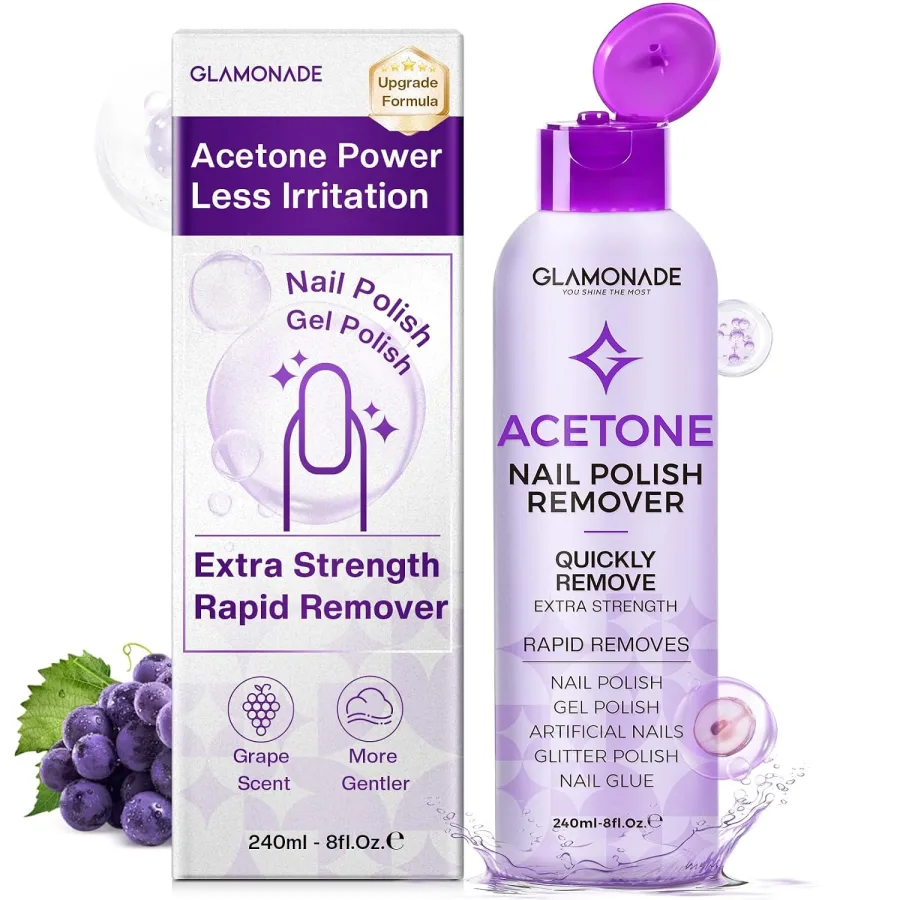
Glamonade Acetone Nail Polish Remover 8 oz Review: Gentle Formula, Bad Bottle
An alcohol-free, vegan acetone remover that is genuinely kind to skin, packaged in a bottle that spills and leaves an oily film behind.
The Full Verification Report
This article is reader-supported. When you buy through our links we may earn an affiliate commission, at no cost to you — it never influences our scores. As an Amazon Associate we earn from qualifying purchases.
Buying the bigger bottle usually feels like the sensible decision. More product, less money per ounce, fewer reorders.
This Glamonade Acetone Nail Polish Remover review is about the version where that logic gets complicated, because the 8 oz bottle contains a formula worth having and a container that actively works against you.
Six weeks of use on regular lacquer, a set of glitter-heavy polish strips, one gel manicure, and an unfortunate encounter with spilled nail glue. My nails are normal-to-dry and acetone reliably leaves my cuticles chalky, which makes the gentleness claim here easy to check.
One thing to flag before anything else: buyers openly contradict each other about whether this is strong enough for gel. I will deal with that head on.
It Is Kinder Than Acetone Has Any Right to Be
The first removal told me something was different, and it took a few days to work out what.
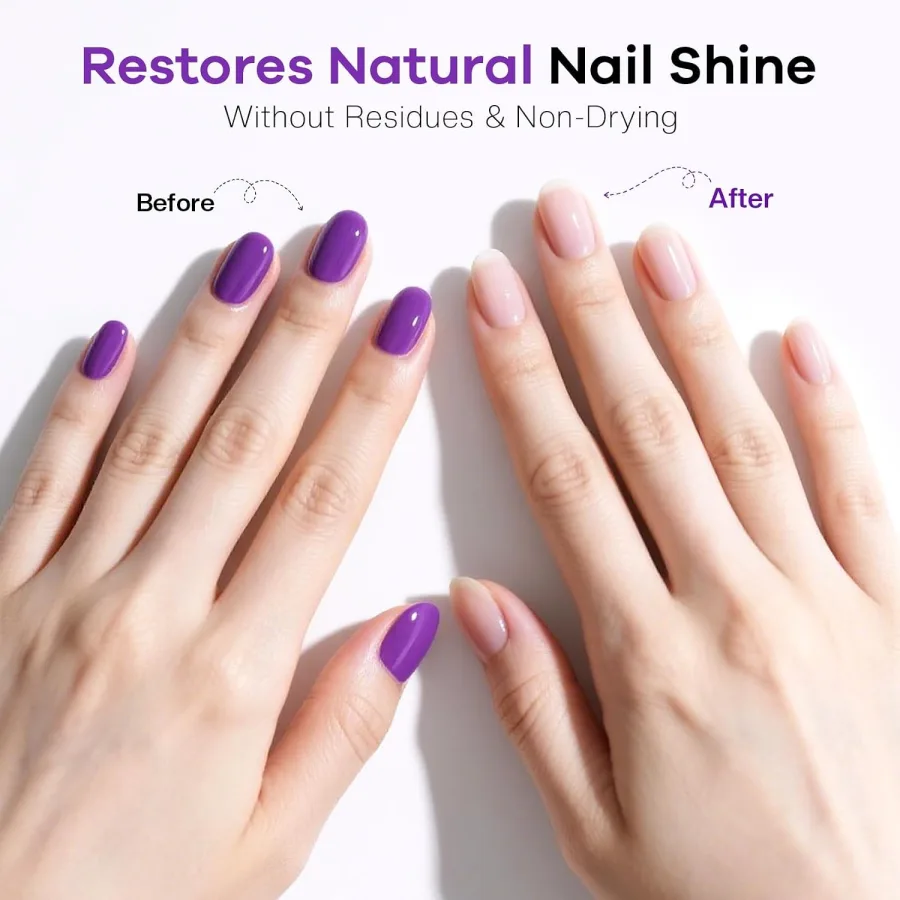
My cuticles did not tighten. Normally the morning after an acetone removal they feel papery and start lifting at the edges, and after six weeks of this that simply did not happen. The nail plate never went chalky either.
The most persuasive account comes from a buyer who had spent years using non-acetone conditioning removers at a higher price point. She switched to this, wears glitter-heavy polish strips, and reports that even though it is acetone it did not dry her skin out, calling it gentle.
That is a meaningful endorsement because she had a baseline to compare against. Someone moving from cheap acetone would notice less.
The alcohol-free formula is likely part of the explanation. Alcohol compounds the drying effect of a solvent, and leaving it out means the acetone is doing its work without a second dehydrating agent alongside it.
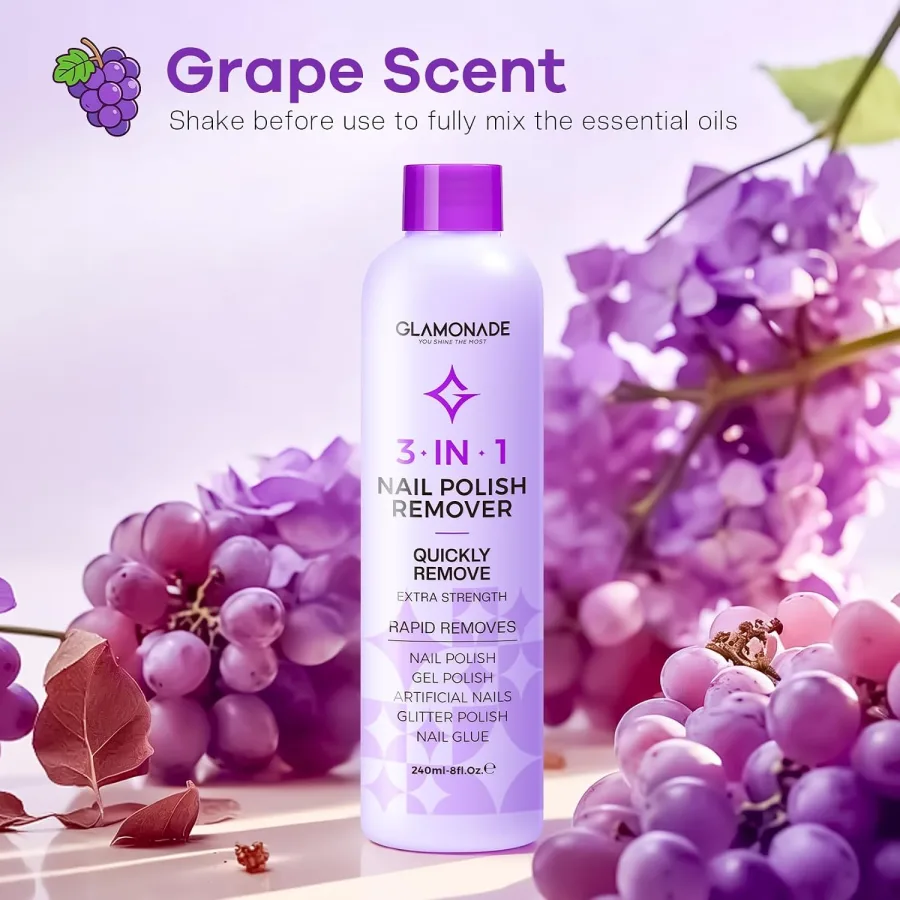
The smell follows the same pattern. A buyer calls it not super stinky, which is understated and fair. There is no strong added fragrance here, so what you get is softened acetone rather than something pleasant.
At a Glance
| Detail | Specification |
|---|---|
| Brand | Glamonade |
| Type | Alcohol-free acetone remover |
| Volume | 8 fl oz (240 ml) |
| Weight | 0.26 kg |
| Best for | Regular polish, polish strips, nail glue |
| Free from | Alcohol |
| Also | Non-irritating, vegan, cruelty free |
| Price band | $8 to $12 |
| Score | Rating |
|---|---|
| Removal Power | 7.8 / 10 |
| Speed & Efficiency | 8.0 / 10 |
| Nail & Skin Kindness | 8.8 / 10 |
| Scent & Comfort | 8.2 / 10 |
| Value & Packaging | 6.8 / 10 |
| Overall | 7.9 / 10 |
Polish Strips Are Where It Excels
Every remover has one job it does better than its price suggests, and for this bottle it is polish strips.
The account that convinced me comes from a ColorStreet wearer whose strips usually involve heavy glitter, printed designs, or two strips layered on one nail. She soaks a cotton pad, holds it in place with nail clips, waits three or four minutes, and reports the polish lifting more easily than with other removers.
That is a genuinely good result. Glitter-heavy strips are among the harder things to take off, because you are dealing with a lacquer film loaded with particles that resist a solvent.
My own experience matched it closely. Three to four minutes of held contact and the strips came away in one piece rather than shredding, which is the difference between a two-minute job and a twenty-minute one.
Regular lacquer is unremarkable in the good sense. It comes off quickly with a soaked pad and no fuss, which is the baseline any acetone remover should clear.
Nail glue was the surprise. A buyer reports it being the only thing that removed nail glue their daughter had spilled on a wooden table, after warm water and scrubbing had already damaged the wood. Read that as two facts: it dissolves cyanoacrylate, and it is a solvent strong enough to affect a finish.
What it handled well
- Polish strips and wraps: three to four minutes of held contact, then they lift in one piece.
- Glitter-heavy strips: the same, which is genuinely impressive.
- Regular lacquer: quick and clean with a soaked pad.
- Cured nail glue: dissolves it, including off hard surfaces.
- Gel: inconsistent. See below, because this is the real question.
Why Alcohol-Free Matters in a Remover
It is the one formulation claim on this bottle that does real work, and almost nobody explains what it means.
Plenty of removers carry isopropyl or denatured alcohol alongside their main solvent. It is cheap, it helps the formula evaporate cleanly, and it thins the liquid so it spreads. From a manufacturing point of view it is a sensible inclusion.
The problem is that alcohol dehydrates on its own account. Put it next to acetone and you have two agents pulling water and oil out of your nail plate at the same time, which is why some removers leave skin feeling tight within minutes rather than hours.
Taking it out changes the aftermath more than the removal. The acetone still strips the polish at the same rate, but there is no second dehydrating agent compounding the effect on the skin around your nails.
That is consistent with what buyers describe. The reviewer who moved here from pricier non-acetone removers specifically notes that despite being acetone it did not dry her skin out, which is the exact result you would predict from removing the alcohol.
It also explains the milder smell. A lot of what people register as the harshness of cheap remover is the alcohol evaporating alongside the solvent rather than the acetone itself.
None of this makes it gentler than an acetone-free remover. It makes it the gentlest acetone option in this group, which is a genuinely useful position if you need acetone for glue or strips.
The Gel Question Buyers Cannot Agree On
This is the part that decides whether the bottle is right for you, and I am not going to smooth it over.
One buyer says it works really good, even on the harder-to-remove gel polish, and wishes only that the bottle were bigger. Another says it is not very strong, that it would not soak off their gel at all, and that they ended up peeling the polish and ruining their nails, then waiting for them to heal.
Those are irreconcilable accounts of the same product, and the second one describes real damage. It deserves weight rather than being dismissed as an outlier.
My own result was closer to the positive account, but only with a foil-wrapped soak of twelve to fifteen minutes. Wiping did nothing, and a loosely held pad did very little.
Two explanations seem likely. Gel systems vary enormously, and some builder and hard gels are formulated not to soak off at all, so no acetone will lift them. And technique matters more with a gentler formula than with professional-strength acetone, because there is less margin for a short soak.
What I take from it is a warning rather than a verdict. It can remove soak-off gel. It is not reliable enough that I would buy it specifically for gel, and the downside of guessing wrong is the scenario that second buyer described.
If gel removal is your main use, our Onyx Professional Acetone review covers the bottle that does it dependably, and the extra couple of dollars buys certainty.
The Bottle Is the Real Failure
Everything above explains the 7.9. This is why it is not higher, and it is entirely avoidable.
The bottle tips over. A buyer describes it falling over for under a minute and spilling everywhere, which tells you how little provocation it needs. That is a stability problem rather than a faulty cap.
The spill is worse than the spill. That same buyer notes it leaves an oily residue on everything it touches which is hard to remove, and I found the same on a laminated surface that took three attempts to clean properly.
Combine that with the fact that it dissolves nail glue off wood, and you have a product that will damage a finished surface if it goes over unnoticed. That is a genuine risk, not an inconvenience.
The frustrating part is how solvable it is. The pump version of this same brand cannot spill at all, because nothing is ever open. Glamonade has already built the answer and put it in a smaller bottle.
How to live with it
- Keep it upright and towards the back of a shelf, never near an edge.
- Work over a towel or a tray rather than directly on a table.
- Cap it between pours instead of leaving it open while you wipe.
- Keep it off wood, laminate and anything painted. It will strip a finish.
- Decant into a stable bottle with a proper base if you have somewhere things get knocked.
- Give gel a foil-wrapped soak of at least twelve minutes, or do not attempt it.
Six Weeks of Using It
The routine settled into something slightly defensive, which tells you most of what you need to know.
I stopped putting it on the bathroom shelf after the first week and moved it to a drawer, upright, brought out only when needed. That is not how you should have to treat a nail product.
Regular removals were quick and pleasant. Soaked pad, wipe, done, and no chalky nails the next morning. On that measure it outperformed every pure acetone I have used.
Polish strips became the thing I reached for it for. Soak a pad, clip it in place, wait four minutes while doing something else, and the whole set comes off cleanly. That workflow is genuinely good.
Gel I approached carefully after reading the negative account, foil-wrapping and waiting fifteen minutes rather than trying to rush it. It worked, and I would not have trusted it on a tighter schedule.
The 8 oz volume is the real payoff and it should not be underrated. Six weeks including a gel removal and a strip set left the bottle around half full, which is considerably better value than the 6.34 oz pump.
If you are getting through polish quickly, the long-wear shades in our best nail polish roundup are what I was removing during testing, and OPI Nail Lacquer in Bubble Bath came off with a single soaked pad every time.
Matching a Remover to What You Actually Wear
Most people own one bottle and use it for everything, which is why so many removers get blamed for failing at jobs they were never suited to.
| What is on your nails | Does this bottle handle it? |
|---|---|
| Regular lacquer | Yes, easily. One soaked pad, no waiting. |
| Glitter polish | Yes. Give it a few seconds of contact first. |
| Polish strips and wraps | Yes, and better than most. Three to four minutes held in place. |
| Soak-off gel | Sometimes. Foil-wrap for twelve minutes or use something stronger. |
| Builder or hard gel | No. These are not designed to soak off at all. |
| Acrylics | No. Use professional-strength acetone. |
| Nail glue | Yes, including off hard surfaces. |
The pattern is clear once it is laid out. This is a very capable everyday remover with a soft ceiling, and the ceiling is exactly where the negative reviews cluster.
If your nails are lacquer, strips and the occasional glue-on, one bottle of this covers your entire routine and does it gently. If you are in and out of gel every three weeks, you need a stronger bottle and this becomes a second one rather than your only one.
Is It Worth $8 to $12?
As a value pick, yes, with clear eyes about what you are accepting.
Against its own pump sibling the trade is stark. Our Glamonade pump review covers the better product: more reliable on gel, grape oil for conditioning, a dispenser that cannot spill, and a higher rating. This bottle gives you more product for less money and takes back most of the refinement.
Against pure acetone the comparison flips. Our C CARE 100% Pure Acetone review covers a bottle that removes more aggressively for similar money, and leaves your nails noticeably worse. If skin kindness is what you want, this wins.
Against an acetone-free remover, this is the option for anyone who needs to remove glue or strips but wants the gentlest acetone they can get.
What holds it to 7.9 is the packaging and the inconsistency, not the formula. At a 4.3 star average it is the weakest performer in this group, and the reasons are fixable ones the brand has not fixed.
Getting Polish Strips Off Without Damage
Since strips are what this bottle does best, the technique is worth setting out properly. Most of the damage people do to their nails happens at removal rather than application.
Strips are lacquer on a flexible backing, pressed onto the nail and adhered along their whole surface. That full-contact bond is why they last, and why picking at one corner tends to take a layer of nail plate with it.
The buyer whose account convinced me uses a method worth copying exactly. Soak a cotton pad, lay it over the nail, then hold it in place with a nail clip so you are not sitting there pressing with a finger. Three or four minutes later the strip lifts.
The clip is the part people skip and it is the part that makes it work. Held contact keeps the solvent against the adhesive instead of evaporating off, and it frees your other hand.
The sequence that works
- Soak, do not dab. The pad should be wet enough to stay wet for four minutes.
- Cover the whole nail. Partial contact lifts part of the strip and you will pick at the rest.
- Clip it in place. Nail clips, a hair clip, or foil. Anything that holds without pressure.
- Wait the full four minutes. Checking at ninety seconds and pulling is how nails get damaged.
- Lift, never peel. If it resists, re-soak for another two minutes rather than forcing it.
- Oil afterwards. Even a gentle acetone has stripped the nail plate by this point.
Done that way, glitter-heavy or doubled-up strips come off in one piece. Rushed, they shred and you end up filing, which thins the nail.
Who Should Buy It, and Who Should Not
Buy it if you wear polish strips or wraps. That is the job it does best and it beats more expensive removers at it.
Buy it if acetone has always dried out your skin and you have been paying more for conditioning removers to avoid that. This is a cheaper route to the same comfort.
Buy it if you want vegan and cruelty free without giving up the ability to dissolve nail glue.
Skip it if gel is your main use, because the feedback is genuinely split and the failure mode is peeling your own polish off. Skip it if you have nowhere stable to store an easily-tipped bottle of solvent. And skip it if you would rather have the better product than the bigger bottle, in which case the pump version is the one to get.
Six weeks in, this is the most frustrating product in the group precisely because the formula deserves better. Glamonade made something genuinely kind to skin and then put it in a bottle you have to guard.
Confirmed
- Noticeably gentler on skin than straight acetone, with buyers reporting no dryness at all
- Lifts glitter-heavy polish strips in three to four minutes
- Alcohol free, vegan and cruelty free, which is unusual in an acetone remover
- Dissolves cured nail glue, including glue spilled on a wooden surface
- The 8 oz bottle is a more sensible size than the 6.34 oz pump version
Flagged
- The bottle tips and spills easily, and the spill leaves an oily residue that is hard to clean
- Buyers contradict each other on gel: some remove it easily, one could not soak it off at all
- It is the lowest-rated remover in this group at a 4.3 star average
Specification
Verified Against 2 Rivals
This Product
Glamonade Acetone Nail Polish Remover, 8 oz
7.9 / 10
Onyx Professional Acetone Nail Polish Remover Kit
8.5 / 10
Glamonade Acetone Nail Polish Remover Pump
8.2 / 10How This Score Was Earned
We Purchase
Bought at retail, anonymously, with our own funds.
We Live With It
A minimum of four weeks of daily use before a word is written.
We Measure
Weighted criteria, identical for every product in the category.
We Re-Verify
Rankings are revisited weekly; scores fall when products do.
 Verified Examiner
 The Verified Verdict
Gentle on skin and good on polish strips, but the bottle spills easily and buyers disagree sharply about whether it is strong enough for gel.
Check Price on Amazon →$8–$12 · price verified today
Common Questions