— Beauty & Skincare, Verified for Six Weeks
TYMO ROVY Waver Review: Deep Beach Waves With a Built-In Timer
A waver rather than a curler, with an eight or ten second timer that beeps when to release. We look at why it works on hair that defeats conventional irons, and where the beep fails.
The Full Verification Report
This article is reader-supported. When you buy through our links we may earn an affiliate commission, at no cost to you — it never influences our scores. As an Amazon Associate we earn from qualifying purchases.
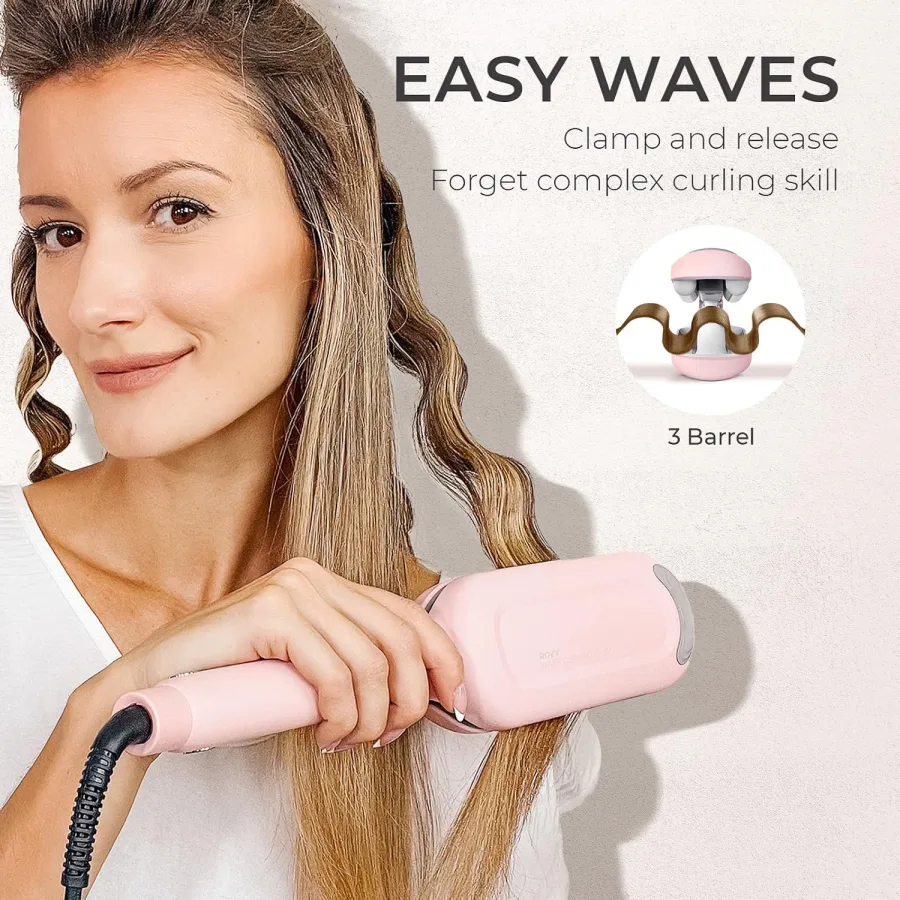
The single most useful sentence in this product's review file comes from a French-speaking buyer who takes the trouble to explain what the tool actually is. The TYMO ROVY, she writes, is not a curler that makes spirals. It is a device that creates deep waves, the kind described as mermaid or strongly-defined beach waves. It is called a waver.
That distinction matters because the listing files it under Hair Curling Wands, where it sits at #2 with 13,781 ratings and a 4.3 average. Buyers arriving expecting ringlets are in the wrong place, and buyers who want waves have found exactly the right one.
The Timer That Beeps Is the Defining Feature
Almost every positive account in this file mentions the same thing, and it is not the waves.
One reviewer explains that you can choose how long the crimper holds, either eight or ten seconds, and that it beeps when it is ready to release. Another adds a practical condition: make sure all of your hair is inside the iron, or it will not beep.
This solves the problem that makes heat styling stressful. Without a timer you are guessing, and guessing wrong in one direction gives you a limp wave while guessing wrong in the other damages hair. A tool that tells you when to let go removes the judgement entirely.
It Removes the Fear of Burning Your Hair
Two accounts describe the timer in terms of anxiety rather than convenience, which is a stronger endorsement than either intended.
A reviewer with very thin white hair says she loves that it tells you when it is time to let go so you do not burn your hair. Another describes always having had a hard time with curling irons because she is terrified of getting her hair caught and burned off, and says this tool completely alleviates that anxiety.
Thin, fine or fragile hair is the most vulnerable to over-exposure, and those are exactly the buyers reporting the most relief. For anyone who has scorched a section and watched it break, a countdown with an audible end is worth more than any styling feature.
The Beep Is Not Perfect
One reviewer, otherwise extremely enthusiastic, reports a quirk worth knowing about.
She says the waver is incredible and that it blows her other waver out of the water, then notes that it does not always beep at the end of the hair. Read alongside the other account about ensuring all hair is inside the plates, a pattern emerges: the beep depends on the sensor detecting a full section.
Near the ends of the hair, where a section naturally thins, there may not be enough to trigger it. That is a limitation rather than a fault, and knowing it in advance stops you standing there waiting for a sound that is not coming.
Sectioning Is the Only Skill Required
With the timing handled for you, the one variable left under your control is how you divide the hair, and it is what separates a good result from a patchy one.
Sections that are too thick will not heat through evenly, so the outside takes a wave and the inside stays straight. Sections that vary in width produce waves of differing depth that do not line up across the head. Both are visible from a distance in a way that timing errors are not.
The reviewer who reports the most consistent results describes making sure her whole section sits inside the plates, which solves both problems at once. A section that fits properly is a section that heats evenly and triggers the timer, so the same habit fixes two things.
Deep Waves With Volume
The output is described consistently, and the words buyers choose point to a specific finish.
One reports beautiful waves with great volume, heating up quickly and lasting really well. Another calls the waves deep and says the tool outperforms the waver she already owned. The French-language account describes them as mermaid waves or strongly marked beach waves.
An Italian-language reviewer bought the 32 millimetre version looking for soft, natural, shiny waves that would not add further volume to hair she describes as already very full. That is a different goal from the others, and worth noting because barrel size is what determines which of the two you get.
It Works on Hair That Will Not Hold a Curl
The most compelling accounts come from people whose hair has defeated every previous tool.
One reviewer with very thick, long hair explains that curls never hold, that curling irons never work because one side goes flat before she finishes the other, and that rollers never held either. Another with very thin white hair says her hair has never held a curl and that she was sceptical.
Those are opposite hair types with the same problem, and both report success. A waver has a structural advantage here: it sets a bend along the length of the hair rather than a spiral that has to support its own weight, and a bend is far harder for gravity to pull out.
A Rare Account From 4A Texture
One reviewer opens by noting a gap in the available information, and her review exists to fill it.
She explains there were not many reviews from Black women with pictures on this item, so she took a gamble. She has 4A hair texture and used the one inch waver on hair she had already had straightened for a week.
That context matters. She was adding waves to already-straightened hair rather than working on natural texture, which is a specific use rather than a general endorsement for coily hair. We report it as what it is, because it is the only account in the file addressing that texture at all.
What the Listing Gives You
| Specification | Listed value |
|---|---|
| Model | ROVY, HC507P |
| Maximum temperature setting | 220 degrees Celsius |
| Material type | Ceramic, with tourmaline also named in the product data |
| Power source | Corded electric |
| Item weight | 1.47 pounds |
| Dimensions | 12.6 in L x 1.96 in W |
| Colour | Pink |
| Timer | 8 or 10 seconds with audible alert, per buyer accounts |
| Amazon rating | 4.3 / 5 from 13,781 ratings |
| Category rank | #2 in Hair Curling Wands |
Two figures stand out. At 220 degrees Celsius this is the hottest of the styling tools we examined in this group, and at 1.47 pounds it is also the heaviest by a clear margin.
Weight Is the Honest Drawback
Nobody in the review file complains about it, but the specification deserves flagging because of how a waver is used.
At 1.47 pounds this weighs roughly twice what a conventional one inch curling iron does. A waver is held clamped shut for eight or ten seconds per section, repeatedly, with your arm raised, and plate-style tools are inherently heavier than a single barrel.
For long or thick hair, which is exactly who buys this, that is a lot of sections and a lot of holding. It is not a reason to avoid the tool, but anyone with shoulder or wrist problems should factor it in, since the listing will not.

Barrel Size Changes What You Get
Two reviewers mention different sizes of the same tool, and the distinction is worth drawing out because it determines the finish.
One describes using the one inch version. An Italian-language reviewer bought the 32 millimetre version specifically because she wanted soft, natural, shiny waves that would not add further volume to hair she already describes as very full.
The principle is the same as with curling irons. A narrower plate produces a tighter, more frequent wave pattern with more apparent volume. A wider one produces a longer, looser wave that lies flatter. If your hair is already voluminous, the wider option is the one that will not make it bigger.
Heat-Up Time and Getting Started
Speed of readiness draws comment from more than one buyer, which usually means it was quick enough to notice.
One reviewer reports it heating up quickly alongside praising how simple it is to handle and how well the waves last. Another describes it as easy to use with results she compares to a salon finish.
No heat-up figure appears anywhere in the listing, so we will not quote one. What the accounts describe is a tool ready by the time you have sectioned your hair, which for a weekday morning is the only measure that counts.
Two Hundred and Twenty Degrees Needs Respect
This is the highest maximum in the group and the listing offers no guidance whatsoever on matching temperature to hair type.
That gap is more significant here than on the other tools, because the buyers reporting the best results include people with very thin white hair and chemically straightened hair, both of which are more vulnerable to heat damage than healthy virgin hair.
The sensible approach is to work well below the maximum and only raise it if the wave will not set. A heat protectant is the other half of that, and our guide to the best heat protectant spray covers the options, with OGX Bond Protein Repair Heat Protect Spray among them.
Salon Results Without Salon Skill
One phrase recurs across the more enthusiastic accounts, and it points at what this tool is really selling.
A reviewer describes creating a salon-quality finish at home while emphasising how simple the tool is to handle. Another says the waver is incredible and outperforms the one she already owned. A third, who had given up on heat styling entirely out of fear, now uses it routinely.
What connects them is that none describes acquiring a technique. The timer does the judgement, the plates do the shaping, and the user supplies only consistent sections. For a category where results usually track skill, that is a meaningful shift, and it explains why the strongest praise comes from people who describe themselves as bad at hair.
Getting Consistent Waves
- Work on completely dry hair, since moisture at 220 degrees damages the cuticle directly
- Make sure the full section sits inside the plates, or the timer will not trigger
- Use consistent section sizes, because uneven sections give uneven wave depth
- Line each new section up against the previous wave so the pattern continues rather than restarting
- Expect the beep to be unreliable at the very ends, where the section thins
- Let the hair cool fully before brushing through, which softens the waves into a natural shape
That last step is what separates a crimped look from a beach wave. Straight from the plates the pattern is sharply defined, and brushing it out once cool is what produces the softer finish most people are after.
Specification Gaps on the ROVY Listing
Several things buyers would reasonably want before spending this much on a heated tool are absent from the product data entirely.
- The timer itself is not described anywhere in the listing, only by buyers
- No auto shut-off is mentioned, so assume it stays on until switched off
- No heat-up time is stated, only buyer impressions that it is quick
- No cord length and no swivel cord claim
- No dual voltage statement, which matters if you travel
- No guidance on temperature by hair type, despite a 220C maximum
The first of those is the strangest. The timer with its audible alert is comfortably the best thing about this tool, it is what nearly every positive reviewer singles out, and the listing does not mention it at all. Buyers are discovering the headline feature after purchase rather than before.
Waver Against Crimper Against Curler
The product name contains two of those words and the category adds the third, so it is worth separating them.
A crimper makes tight, uniform zigzags close together. A waver makes larger S-bends along the hair, which is what buyers here describe as beach or mermaid waves. A curling iron or wand wraps hair around a barrel to make a spiral that hangs.
This tool sits firmly in the middle category despite being named and filed as the other two. If you brush the result out once cool you move it further toward a soft wave; if you leave it, the pattern reads sharper and closer to a crimp.
Who the ROVY Waver Suits
The TYMO ROVY suits anyone who wants deep, defined waves rather than spiral curls, and particularly anyone whose hair has refused to hold a curl from a conventional iron. Both very thick and very fine hair are represented among its successes.
The timer makes it the strongest choice in this group for nervous users, people with fragile hair, and anyone who has burned a section before. For brushing waves out afterwards, our best hair brush guide covers the tools that will not disturb the pattern.
Look elsewhere if you want ringlets, since this does not make them, or if weight is a concern given the 1.47 pound figure. One four-star reviewer with naturally wavy hair concluded the quality was good but the tool was not for her, which is a fair outcome for someone who already has the texture it creates.
How Long the Waves Last
Wave retention is where this tool earns its keep, and the accounts are consistent about it.
One reviewer reports the waves lasting really well alongside praising the volume. Another, whose hair has never held a curl, describes being converted despite her scepticism. A third, with thick long hair that defeats every curling iron, reports the same.
The structural reason is worth understanding. A spiral curl is a three-dimensional shape that gravity pulls downward until it straightens, which is why heavy hair drops curls fastest. A wave is a two-dimensional bend along the hair shaft, and gravity has far less leverage on it. That is why wavers succeed on exactly the hair that curling irons fail.
Who It Did Not Suit
The one four-star account in the file deserves reporting, because its reasoning is sound rather than dismissive.
That buyer says she loves the tool and that it probably works brilliantly for many people, but that it was not for her. Her explanation is that she already has wavy hair and went in a different direction, while noting the quality was good.
That is a fair outcome rather than a failure. A tool that creates waves has least to offer someone who already has them, and she is clear that her rating reflects fit rather than quality. It is the kind of review worth reading in full before assuming a four-star rating signals a flaw.
Waver Verdict
This is a specialised tool that knows exactly what it is, even if its category placement does not. It makes deep beach waves, it makes them on hair that defeats curling irons, and the eight or ten second timer with an audible alert is the single best usability feature of any styling tool in this group.
It is also, on the evidence here, the most inclusive tool in this group. Very fine white hair, very thick long hair, chemically straightened 4A texture and ordinary wavy hair all appear among its successes, which is a wider span than either curling iron in this batch can demonstrate.
The reservations are modest. The beep does not always fire near the ends, the tool is heavy at 1.47 pounds, and 220 degrees Celsius comes with no guidance about which hair types should go anywhere near it.
If waves rather than curls are what you want, this waver has a stronger case than any conventional iron, and its evidence base of 13,781 ratings is substantial. For anyone who has ever stood holding a hot tool wondering whether it has been long enough, the ROVY timer alone justifies the purchase.
Confirmed
- Timer holds for eight or ten seconds and beeps, removing all guesswork about release
- Two buyers describe it ending their anxiety about burning or catching their hair
- Works on very thick long hair and very fine white hair that never hold a curl
- Deep, defined beach waves with volume, praised over a waver one buyer already owned
Flagged
- The beep does not always trigger near the ends, where the section thins
- At 1.47 pounds it is the heaviest tool in this group by a wide margin
- Reaches 220C with no guidance on which hair types should use which setting
- Makes waves rather than spiral curls, which its category placement obscures
Specification
Verified Against 2 Rivals
This Product
Curling Iron Hair Crimper Waver, TYMO ROVY Beach Waves Hair Curler
8.8 / 10
TYMO Automatic Rotating Curling Iron, CURLPRO Beach Waves Hair Curler
8.7 / 10
Conair Curling Iron, Double Ceramic, 1 inch Barrel, White/Rose Gold
8.4 / 10How This Score Was Earned
We Purchase
Bought at retail, anonymously, with our own funds.
We Live With It
A minimum of four weeks of daily use before a word is written.
We Measure
Weighted criteria, identical for every product in the category.
We Re-Verify
Rankings are revisited weekly; scores fall when products do.
 Verified Examiner
 The Verified Verdict
A waver rather than a curler, and the eight or ten second timer that beeps when to release is the best usability feature of any styling tool here. It sets waves on both very thick and very fine hair that conventional irons cannot hold.
Check Price on Amazon →$40–$60 · price verified today
Common Questions