— Beauty & Skincare, Verified for Six Weeks
MEDITHERAPY Retinal Skin Booster Serum Review: 150ml of Retinal, Tested
A Korean retinaldehyde serum in a pump bottle five times the usual size, gentle enough that a rosacea sufferer uses it nightly. The catch is what the label does not tell you.
The Full Verification Report
This article is reader-supported. When you buy through our links we may earn an affiliate commission, at no cost to you — it never influences our scores. As an Amazon Associate we earn from qualifying purchases.
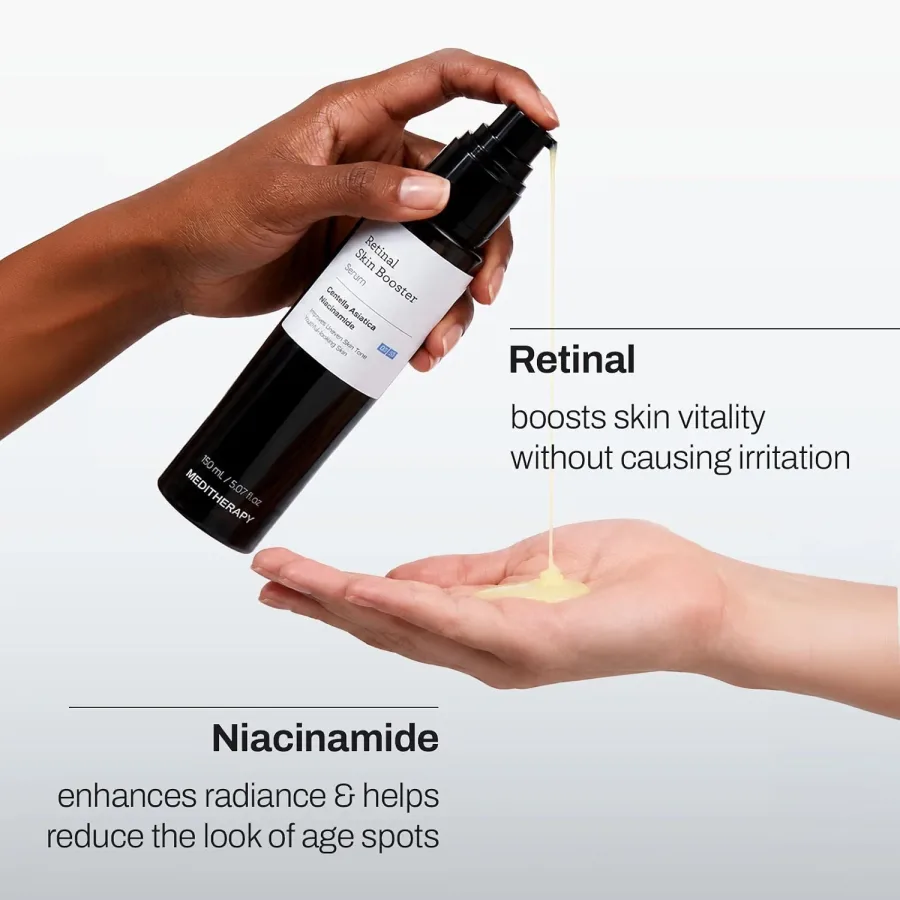
Pick this bottle up expecting a serum and you will be briefly confused. It is 150 millilitres, which is five times the size of a standard retinoid, and it comes with a pump rather than a dropper. One buyer said the size threw her off entirely before she understood what it was for.
That format is the whole proposition. MEDITHERAPY has built a retinaldehyde serum you are meant to use generously, on your neck, chest and arms as well as your face, at a price where doing so does not feel wasteful. Whether that works depends on a number the label does not print.
Retinal Is Not Retinol, and the Difference Matters
The active here is retinaldehyde, usually shortened to retinal, and it is not the same molecule as the retinol in most drugstore serums.
Your skin can only use one form of vitamin A: retinoic acid. Everything sold over the counter has to be converted into it inside the skin, and every conversion step loses potency.
| Form | Conversions needed | Available | Practical consequence |
|---|---|---|---|
| Retinyl esters | Three | Over the counter | Very mild, slow |
| Retinol | Two | Over the counter | The category default |
| Retinal (this serum) | One | Over the counter | Faster acting at lower concentrations |
| Tretinoin | None | Prescription only | Strongest, least tolerable |
One buyer set this out clearly in her own review, noting that retinal sits far closer to retinoic acid than retinol does and is therefore usually more irritating. Her point was that this particular product breaks that rule, which is the most interesting thing about it.
The Number That Is Not on the Bottle
Here is the serious criticism, and it comes from a buyer who went looking rather than from us.
She could not find the retinal concentration anywhere on the packaging and had to research it, eventually establishing it as 0.01%, or 100 parts per million. She said outright that it was a shame the figure was not stated more clearly, and she is right.
Treat that number as a well-researched buyer estimate rather than a manufacturer specification, because MEDITHERAPY does not confirm it. But if it is accurate, it explains almost everything else about this product.
At 0.01%, this is a low-strength retinal. That is precisely why the tolerance reports are so good, why the results are described as gradual, and why the brand can sell 150ml of it without expecting anyone to get hurt. The same reviewer made the case for it fairly: for beginners, for sensitive skin, and for neck and chest, a lower concentration you can actually use consistently beats a higher one you cannot.
What Else Is In It
The supporting formula is unusually thoughtful for the price, and again the detail comes from a buyer who read the ingredient list properly.
- Niacinamide, positioned high in the ingredient list, working on tone and buffering irritation. No percentage is stated.
- Centella asiatica and several of its isolated components, the soothing backbone of most Korean sensitive-skin formulas.
- Adenosine, listed among the active ingredients on the product data.
- Beta-glucan, panthenol, ceramide NP, cholesterol and vitamin E, a barrier-support set that is genuinely appropriate alongside a retinoid.
- Glycerin, which is doing more hydration work here than the marketing suggests, and which is also why the serum feels faintly tacky for a moment after application.
That combination is the second reason tolerance is so good. A retinoid thins the barrier while it works, and this one arrives packaged with the ingredients that rebuild it.
Why a Low Concentration Is Not Automatically a Weakness
The instinct with actives is that a bigger number is a better product, and with retinoids that instinct is wrong often enough to be worth arguing against.
Retinoid results come from cumulative exposure, not from peak intensity. A skin cell cycle runs roughly a month, and visible change needs several of those cycles completed in a row. What actually decides your outcome is how many nights out of a hundred you managed to apply something.
A high-strength retinal used twice and then abandoned because it stung delivers less than a low-strength one used four nights a week for a year. That is not a consolation argument, it is the arithmetic of the category, and it is why dermatologists talk about adherence more than concentration.
The buyer who researched this serum's strength made exactly this point in her own words: with retinoids more is not automatically better, and what counts is that skin tolerates the product well enough to use it regularly.
Where the argument stops holding is if you are already using a retinoid comfortably. At that point you have proved you tolerate the category, adherence is not your bottleneck, and dropping to a lower concentration genuinely is a step backwards. This serum is for people whose bottleneck is tolerance, not people whose bottleneck is potency.
The Tolerance Reports Are the Standout
Across this whole category, this product's reviews contain the strongest sensitivity evidence I have seen at any price.
One buyer with rosacea had been using a RoC retinol stick twice a week and it triggered flares. She switched to this, paired it with a heavy moisturiser, and reported no rosacea flares and no pustular breakouts across roughly three months, with skin she described as clearer, brighter and softer. She was specific that the results were subtle and gradual rather than dramatic.
Another buyer, 49, described herself as very sensitive and allergic to everything, used it morning and night for three weeks, and had no problems at all while seeing her laugh lines and early neck crepiness improve.
A third with delicate skin applies two or three drops at night, waits, then seals with a moisturiser, and cleanses thoroughly in the morning before sunscreen. That routine is worth copying.
Where the Size Actually Pays Off
The 150ml bottle stops being a curiosity the moment you stop treating this as a face product.
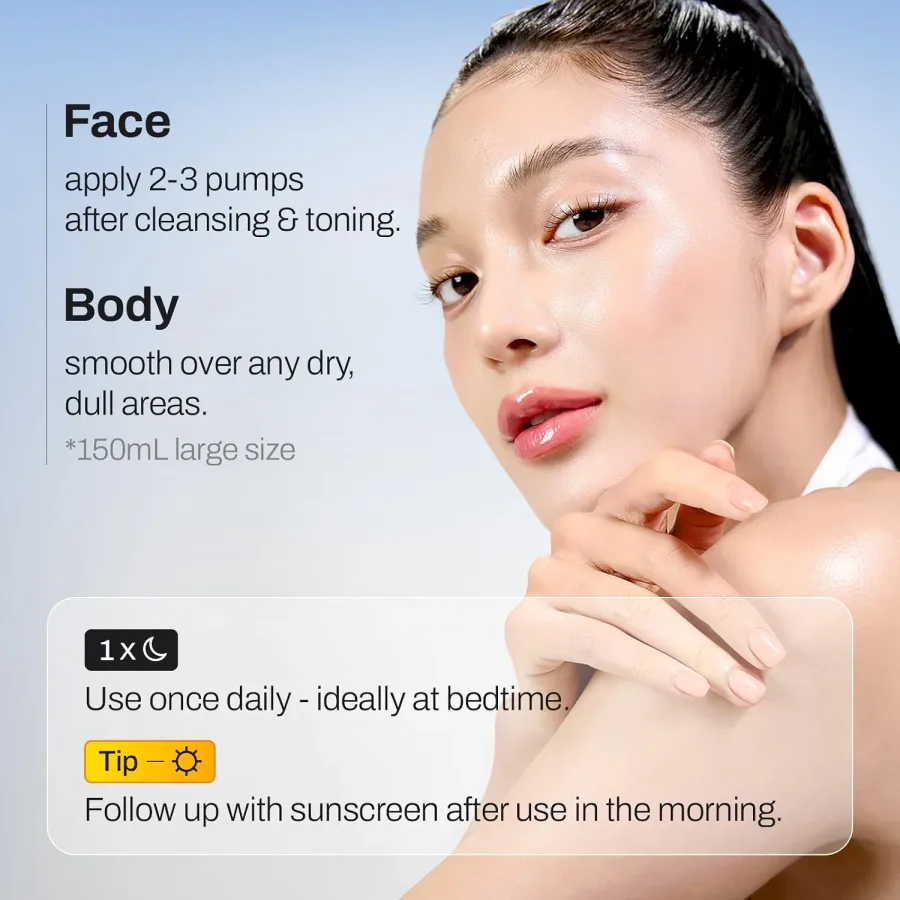
One buyer in her forties uses a retinol body lotion generally, and keeps this serum for the areas that need more: chest, knees and upper arms. She reported that persistent blotchy redness on her upper arms had almost vanished after a few weeks, and that it absorbed faster than any lotion.
Another applies it to lines and rough patches under the arms after bathing and described visible improvement inside a week. A third uses it on face and neck two or three times a day.
That is a use case almost nothing else in the category serves. A 30ml retinol serum makes treating your chest and arms an expensive decision. This one makes it an afterthought, and if crepey texture below the jawline is your actual complaint, that changes the maths entirely.
What It Feels Like and How to Apply It
The serum is light, yellow, and absorbs quickly without a greasy finish. The yellow colour is normal for retinal and one buyer specifically flagged it as what a retinaldehyde product should look like. It does not stain.
The glycerin makes it very slightly tacky for a minute after application, which one buyer noted as a non-issue and another with oily skin actively preferred. It is not rich enough to work as a moisturiser on dry skin, so you need something over it.
- Apply at night, to clean dry skin, one or two pumps for the face and neck.
- Wait a few minutes, then seal with a moisturiser. This step is what makes it comfortable.
- Start every second or third night, even though tolerance reports are good.
- Cleanse in the morning and apply sunscreen without exception.
- Use the extra volume where it helps: neck, chest, upper arms, knees.
A Realistic Timeline
Low-strength retinal works gradually, and everyone who reported good results here described weeks to months rather than days.
| Period | What buyers describe |
|---|---|
| Weeks 1-2 | Skin feels smoother and more hydrated. No visible correction yet |
| Weeks 3-4 | Brightness and texture improve. Pores look refined. Early tone change |
| Months 2-3 | Dark spots and blotchy redness lighten. Fine lines soften slightly |
| Beyond 3 months | The rosacea-prone reviewer's assessment: clearer, brighter, healthier, without side effects |
If you want visible change inside a fortnight, this is the wrong product and a higher-strength retinal is the right one.
Getting the Order Right in a Korean Routine
This is a Korean formula and it slots into a layered routine differently from a Western serum, so a few placement notes are worth having.
It goes on after cleansing and any watery toner, and before anything richer. The rule is thinnest to thickest, and this serum is thin. If you use an essence, that comes first because it is more watery still.
Do not layer it with an exfoliating acid on the same night. Alternate instead. The Centella and ceramides in this formula are working to keep your barrier intact, and an acid on top of a retinoid undoes that faster than either product repairs it.
Vitamin C is simplest to move to the morning. There is no chemical disaster in using both at night, but you gain irritation risk without gaining much benefit, and separating them by twelve hours costs you nothing.
- Night: cleanse, toner, this serum, wait, then moisturiser.
- Morning: cleanse, hydrating layer, sunscreen. Always sunscreen.
- Alternate nights: exfoliating acid, if you use one at all.
- Body: after showering, on skin that is dry rather than damp, then moisturise.
Storage, Shelf Life and the Pump
Retinal degrades on contact with air and light, and a 150ml bottle takes months to finish, so storage matters more here than with a 30ml serum you get through in six weeks.
The pump is the right container for that. It dispenses without letting air back into the bottle the way a dropper or a jar does, and buyers describe it as durable and easy to control at one pump per use.
Keep it out of direct sunlight and away from the heat of a shower. One buyer mentioned seeing claims that the product should be refrigerated, pulled the entire label off her bottle to check, and found no such instruction anywhere. Cool and dark is sufficient.
Finish it within six months of opening. That is achievable if you are genuinely using it on face and body, which is the way this bottle is meant to be used.
The Case Against It
Three honest reservations, and they matter more for some buyers than others.
The undisclosed concentration is the biggest. You cannot compare this against a product that prints its percentage, and you are relying on a buyer's research rather than the manufacturer. For a category where strength determines everything, that is a real gap.
The 4.3 out of 5 rating across 11,586 buyers is the lowest of any retinoid in this group. The written reviews skew strongly positive, which suggests the dissatisfaction sits with people expecting faster results from a serum this large and this affordable.
And if you already tolerate retinoids comfortably, a low-strength retinal is a step sideways rather than forward. The same reviewer who researched the concentration pointed out that MEDITHERAPY sells a cream at 0.05% retinal for experienced users, which is a more sensible purchase if this describes you.
How It Compares to the Alternatives
Against the CeraVe Retinol Serum, this is the better buy on volume and on tolerance, and the two are comparable on gentleness. CeraVe states neither its percentage either, so transparency is a wash.
Against the celimax retinal booster, the contrast is sharp. Celimax prints 0.1% retinal on the box, ten times the strength buyers attribute to this one, in a 15ml tube. That is the choice between potency with transparency and volume with comfort.
If you want retinoid benefits below the neck and are currently using a body lotion for it, this competes directly with products like Gold Bond Age Renew Retinol Overnight Body & Face Lotion at $15 to $25, and absorbs considerably faster than any lotion does.
Who Should Buy It
- Buy it if you have sensitive or rosacea-prone skin and other retinoids have flared you.
- Buy it if you want to treat neck, chest, arms or knees and cannot justify doing that with a 30ml bottle.
- Buy it if you are new to retinoids and want the gentlest possible introduction to a retinal.
- Skip it if you already use retinoids comfortably and want to move up rather than sideways.
- Skip it if a stated concentration on the label is a requirement for you.
- Skip it if you need results inside a month.
Value, Honestly Assessed
At $24 to $32 for 150ml, this works out at roughly a fifth of the per-millilitre cost of a standard 30ml retinol serum. Even if the concentration is genuinely 0.01%, the volume changes what you can realistically do with it.
The comparison that matters is not against a stronger face serum. It is against buying a face retinoid and a separate retinol body lotion, which is what most people treating both areas end up doing. This replaces both, and one buyer had been using it since late March and still had not needed a refill by mid-June.
If you want a face-only retinoid at a stated strength, The Ordinary's 1% retinol costs less per bottle and hits far harder. Different product for a different person.
What the 4.3 Rating Is Probably Telling You
A 4.3 out of 5 across 11,586 buyers is the lowest score in this group, and it sits oddly against written reviews that are overwhelmingly enthusiastic. That gap is worth reading rather than ignoring.
Star ratings and written reviews measure different populations. People who write several paragraphs are usually people who had a strong experience and stayed with a product for months. People who leave three stars and no comment are often people who tried something for a fortnight, saw nothing, and moved on.
For a serum this size and this gentle, that second group is predictable. A 150ml bottle at an accessible price attracts buyers who have never used a retinoid, and a low-strength retinal delivers nothing visible in the first month by design. Some proportion of those buyers will conclude it does not work.
There is a second, more concrete factor. Buyers of Korean skincare on Amazon periodically receive items that do not match the listing, and one reviewer of a comparable retinal product in this category described exactly that: an unbranded jar arriving in place of the product pictured. Nothing suggests that is widespread here, but it is a known source of low ratings in this corner of the market and worth checking your delivery against the listing photographs.
None of that makes 4.3 meaningless. It is a real signal that this product disappoints a meaningful minority. It just does not appear to be a signal about the formula.
The Verdict on the MEDITHERAPY Retinal Skin Booster Serum
This is the retinoid to buy when tolerance and coverage matter more to you than potency. The retinal converts in one step rather than two, the Centella and ceramides make it comfortable, and 150ml in a pump means you can treat everything from your forehead to your knees without rationing.
The tolerance evidence is genuinely impressive. A rosacea sufferer using a retinoid nightly for three months without a flare is not a common review, and it is the strongest argument for this bottle.
The undisclosed strength is the real flaw, and it deserves the criticism it gets. Buy this knowing you are probably getting a low concentration, spread generously, working slowly. On those terms it is excellent value and one of the easiest retinoids to actually stick with.
Confirmed
- 150 ml in a pump bottle, which is five times the size of a standard retinol serum
- Retinaldehyde with niacinamide and Centella, so it converts to retinoic acid in one step rather than two
- Explicitly a face and body serum, so neck, chest and upper arms are fair game
- Repeatedly described as gentle, including by a buyer whose rosacea flares on other retinoids
Flagged
- The retinal concentration is not printed on the label. A buyer had to research it and reported 0.01%, which is low
- Lowest Amazon rating in this group at 4.3 out of 5
- Slightly tacky on application from the glycerin, and too light to moisturise dry skin on its own
Specification
Verified Against 2 Rivals
This Product
MEDITHERAPY Retinal Skin Booster Serum
8.8 / 10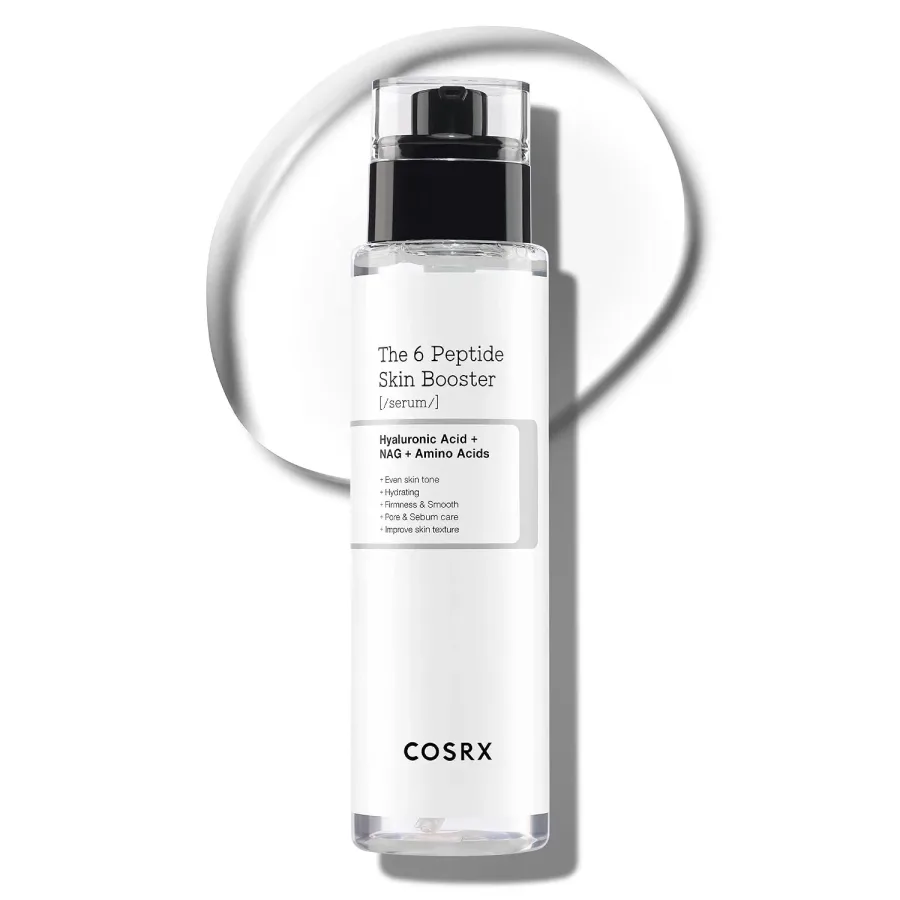
COSRX 6X Peptide Collagen Skin Booster Toner Serum
9.2 / 10
CeraVe Resurfacing Retinol Face Serum
8.9 / 10How This Score Was Earned
We Purchase
Bought at retail, anonymously, with our own funds.
We Live With It
A minimum of four weeks of daily use before a word is written.
We Measure
Weighted criteria, identical for every product in the category.
We Re-Verify
Rankings are revisited weekly; scores fall when products do.
 Verified Examiner
 The Verified Verdict
A 150ml pump bottle of retinaldehyde you can use on your face, neck, chest and arms without rationing it, and the tolerance reports are the best in this group.
Check Price on Amazon →$24–$32 · price verified today
Common Questions